

Cornici in legni recuperati
The path is marked. It is difficult to follow – Female Minimalist Artwork
The path is marked. It is difficult to follow – Female Minimalist Artwork
Couldn't load pickup availability
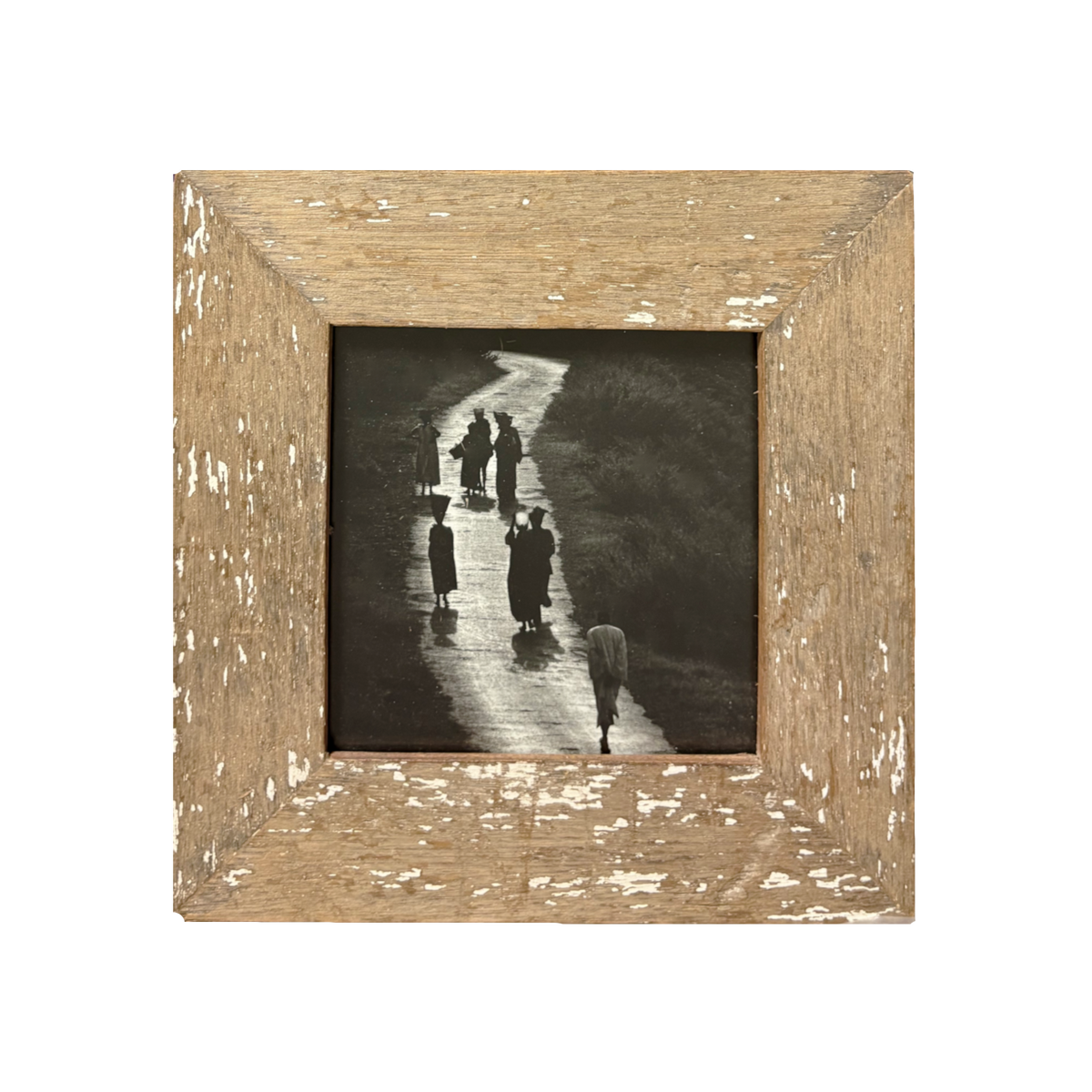
Destiny and Freedom: Silhouettes of Women in Backlight on a Path of Light
The Conscious Search Through Natural Imperfection
The Frame
The work introduces a decisive material shift into the Minimalist collection: here, wood does not merely emerge—it reigns, and the paint is all that remains. Compared to previous works in the same collection, where white paint formed the primary field and natural wood emerged as a revelation through cracks, the hierarchy in this piece is completely reversed. The warm beige of the natural wood is the dominant color of the frame, and the remnants of white paint—distributed irregularly across the surface—are the last traces of a previous history, now almost erased by time and use.
The wood grain is, quite deliberately, the protagonist. Every fiber is legible, every knot tells of a direction of growth, and every variation in tone between light and dark in the wood texture creates a surface with the visual complexity of a miniature landscape. The worn edges complete the profile of an object that has endured time with dignity, not nostalgia.
The square format—23 × 23 cm—gives the whole a solidity and completeness that a rectangle would lack. The frame embraces the photograph without directional hierarchy: there is no dominant top or subordinate bottom, only a center toward which everything converges.
The Image
The photograph is built on light, or rather: on the struggle between light and darkness that backlighting brings to its purest form. A group of women walks along a sun-drenched path—but the light source is behind them, and thus their bodies become dark silhouettes, faceless presences, universal figures rather than recognizable individuals.
This technical choice—backlighting—transforms a documentary scene into something closer to allegory. We do not know who these women are, where they are going, or what time or place they inhabit. We only know that they walk, together, toward the light, along a path that the light itself has traced before them.
The title resonates with all its ambiguity: the path is marked—by light, by necessity, by destiny, by the expectations of others. Following it is demanding—not impossible, not denied, but not without cost. There is a quiet wisdom in these words, which neither comfort nor discourage: they simply name the condition. One stops, looks back, and proceeds resolutely, just like these silhouettes.
The composition is essential and powerful: the luminous path cuts diagonally across the image, the figures travel along it into the distance, and the viewer's gaze follows them without being able to reach them. An image that invites prolonged viewing, and that changes slightly every time.
Color Palette
The palette of this work is built on a dialogue between warm and cool, material and immaterial, concrete and poetic—three pairs of opposites that hold each other in balance without canceling one another out.
The warm beige of the natural wood carries with it the full range of organic neutrals: sand, light clay, wheat, antique ivory. It is a chromatic base that the body recognizes as familiar, like the texture of a plastered wall or raw canvas. The remnants of white paint interrupt this continuity with small patches of cool, almost lunar light—as if the frame were still deciding what to be.
The photograph introduces its own internal polarity: the deep black of the female silhouettes against the dazzling silver-white of the backlighting. It is a range reduced to the minimum—practically no mid-grays, no transitional shades—which makes the image almost graphic, like an engraving or a cut-out silhouette.
The point of balance between frame and image is chromatically perfect: the warmth of the wood softens the photograph's extreme contrast, while the black-and-white of the scene echoes and amplifies the remnants of paint on the frame. The two elements read as a single visual organism, not as a photograph inside a frame.
Notes for Decor and Placement
The human presence in the photograph—even reduced to silhouettes—makes this work particularly suited to spaces of transition and threshold: entrances, hallways, landings, stairs. Places where one passes through, arrives, and departs, where the very concept of a journey has an immediate physical resonance.
Dimensions:
- Frame - external dimensions 23x23 cm
- Image - internal dimensions 15.5x15.5 cm
- Light - visible size 13x13 cm
Share
View the frame in your environment
With our interactive viewer, you can see how the frame or frame composition will look in your real environment before you buy it. Here's how to use the tool:
- Upload a photo of your space (living room, bedroom, office, etc.) by clicking on the shaded area or dragging an image directly.
- Place the product where you want in your photo. Just drag it with your mouse or your finger (on touch devices).
- Adjust the size using the "Size" slider to fit the product to the proportions of your environment.
- Rotate the product with the "Rotation" slider until you find the perfect angle (ideal for rectangular frames, which can be hung both vertically and horizontally).
- Start over at any time by clicking the "Retry" button to upload a new photo or reposition the product.
Tips for better results:
- Take large photos of the space to give yourself more room to place your frame or frame arrangement.
- Make sure the lighting is good to get a realistic view.
- Try different angles and positions to find the perfect solution for your space.
Now you can visualize how this frame or composition of frames will integrate perfectly into your environment!
If you need more specific advice, you can contact us by email at comunicazione@capebest.it or at +393926596260 (also WhatsApp).
📞 Telephone and WhatsApp orders: +39 392 6596 260.