

Cornici in legni recuperati
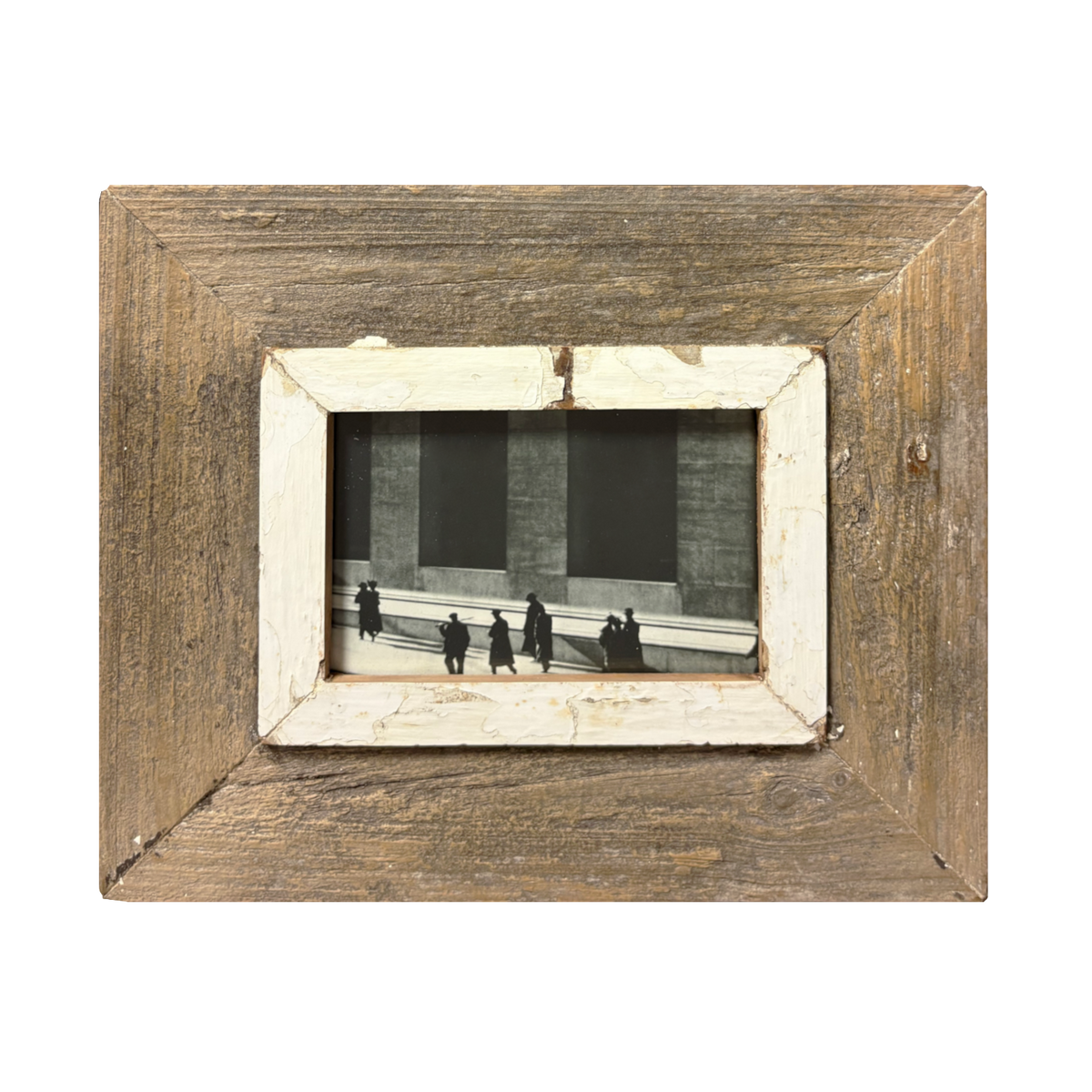
Great Institutions, Small Men – Minimalist Photography 28×23 cm
Great Institutions, Small Men – Minimalist Photography 28×23 cm
Couldn't load pickup availability
Three Figures and a Monumental Building: The Geometry of the Human Scale
Natural Wood Frame and Off-White Matting: Honest Materiality
The Frame
It is difficult to find a more honest wood than this. The frame of the artwork is made of untreated natural wood, with all its materiality on full display: pronounced grains that cross the frame like lines of ancient text, knots that mark the passage of time with the same authority as a signature. The primary color is the light brown of raw wood, warm and earthy, which has never tried to appear as anything other than what it is. Completing the structure, an off-white wooden matting — not optical white, but that slightly yellowed white that has seen many seasons — creates a second inner frame that separates the raw wood from the image with silent elegance, almost as if preparing the viewer to catch their breath before the photograph.
The horizontal 23 × 28 cm format is deliberately compact and intimate. This is not a work that seeks to dominate the wall: it wants to be discovered, approached, and read up close. Its strength lies precisely in this reduced scale, which forces the viewer to take a step toward it — and to linger.
The Image
We are in the 1950s, in a city that is not named but belongs to our mental maps: that monumental architecture, those very tall colonnades, those stone surfaces that leave no doubt about the will of those who built them. Institutions — whether governmental, financial, or religious — have always known how to speak through stone, how to make the individual feel small not to humiliate them, but to remind them that there is something greater than themselves.
And yet, at the foot of that facade that occupies almost the entire background, three or four figures walk peacefully, in their 1950s coats and hats, perhaps unaware that they have become the true measure of everything. They are the real subject of the work — not the building. The title "Great institutions, little men" is neither a judgment nor a bitter critique: it is a visual, almost geometric, observation. The photograph in pure black and white, without any color tinting, amplifies the contrast between the architectural mass and the lightness of the human figures, between the permanence of stone and the fleeting step of those walking before it.
There is something deeply cinematic about this composition — a shot that Cartier-Bresson would have recognized, that decisive moment in which geometry and life meet for an instant and then separate forever.
The Color Palette
Here, the colors work through subtraction, and they do so with great awareness. The natural wood of the frame brings with it the entire vocabulary of the earth: warm browns, muted ochres, and grains ranging from hazel to dove gray depending on how the light meets them. It is not a flat color — it is a surface that changes, breathes, and transforms depending on the time of day and the angle from which it is viewed. The off-white matting acts as a transition between this warm, organic world and the rigor of the black-and-white photograph: it is the moment when the woods end and the city begins.
Inside the frame, the image thinks in pure, high-contrast black and white: the deep grays of the monumental stone, the black of the figures in silhouette, the cold white of the sky. There is no sepia, no warmth — and this choice is anything but accidental. The coldness of the black and white amplifies the sense of distance between the institution and the individual, between the permanent and the transitory. In this work, warmth is brought only by the frame — as if the living, seasoned wood were there to remind us that outside the frame, life continues to be soft and organic.
Notes for Decor and Placement
This work carries a dual soul — simple in its frame, intellectual in its subject — and this duality is exactly what makes it so adaptable to different settings. It fits perfectly in industrial-style spaces or urban lofts, where raw wood and knots resonate with exposed masonry, oxidized metals, and concrete floors. But it works just as well in more classic interiors or home libraries, where the photographic subject — with its historical and visual weight — finds natural companions among books, antiques, and vintage prints.
For complementary materials, think of raw wool, felt, natural leather, wrought iron or burnished steel surfaces, and unpainted solid wood shelving. The compact 23 × 28 cm format makes it perfect for a wall arrangement with other small or medium-format works: three or five pieces lined up on a neutral wall create a gallery with a highly refined editorial feel. Alternatively, it is ideal on a desk, a tall shelf, or a bedside table — anywhere you want a silent but present companion, something that invites you to stop and think.
In professional spaces — law firms, executive offices, creative agencies — this work finds a particularly effective place: the title and subject open up subtle interpretations of the relationship between the individual and the structure, between the human and the institutional, which in certain work environments speak with almost programmatic precision.
Dimensions:
- Frame - external dimensions 23x28 cm
- Image - internal dimensions 10x15 cm
- Light - visible size 8.5x13 cm
Share
View the frame in your environment
With our interactive viewer, you can see how the frame or frame composition will look in your real environment before you buy it. Here's how to use the tool:
- Upload a photo of your space (living room, bedroom, office, etc.) by clicking on the shaded area or dragging an image directly.
- Place the product where you want in your photo. Just drag it with your mouse or your finger (on touch devices).
- Adjust the size using the "Size" slider to fit the product to the proportions of your environment.
- Rotate the product with the "Rotation" slider until you find the perfect angle (ideal for rectangular frames, which can be hung both vertically and horizontally).
- Start over at any time by clicking the "Retry" button to upload a new photo or reposition the product.
Tips for better results:
- Take large photos of the space to give yourself more room to place your frame or frame arrangement.
- Make sure the lighting is good to get a realistic view.
- Try different angles and positions to find the perfect solution for your space.
Now you can visualize how this frame or composition of frames will integrate perfectly into your environment!
If you need more specific advice, you can contact us by email at comunicazione@capebest.it or at +393926596260 (also WhatsApp).
📞 Telephone and WhatsApp orders: +39 392 6596 260.