

Cornici in legni recuperati
Nature in its Place – Geometric and Natural Minimalist Artwork
Nature in its Place – Geometric and Natural Minimalist Artwork
Couldn't load pickup availability
Order and Freedom: Rigorous Geometries Between Tractor Tracks and Wild Harmony
Conscious Balance Between Human Intervention and Untouched Natural Beauty
The Frame
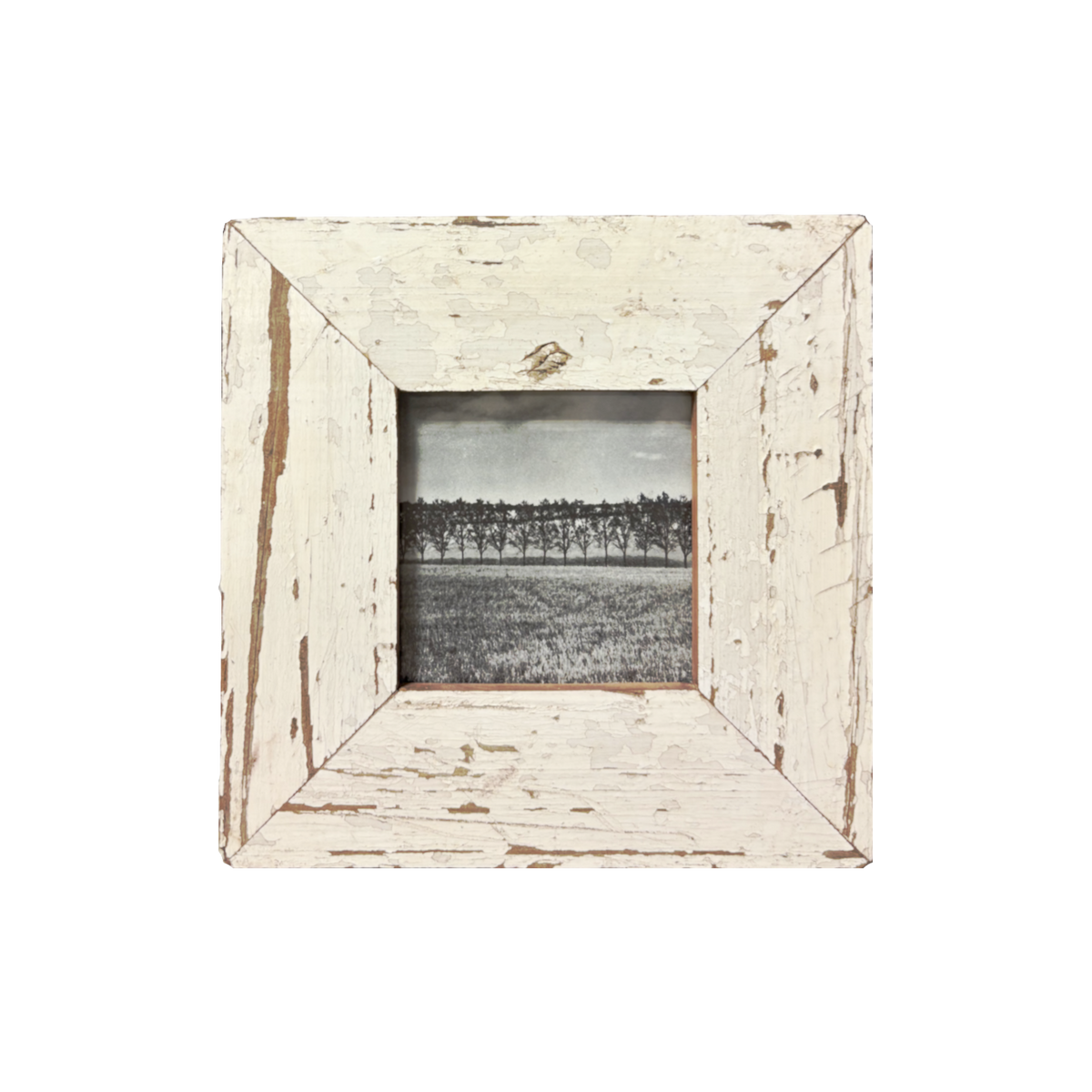
The frame of the artwork is the most eloquent of the Minimalist collection: it does not simply contain the photograph — it interprets it. The antique wood is covered with a layer of off-white paint that time has worked with a consistency that no artisan could simulate at the workbench: the cracking is widespread, layered, almost total. The paint lifts in irregular flakes like the bark of a plane tree, revealing beneath it the natural wood with its warm grain and living texture.
The worn edges tell the story of an object that had another life before this one — and this silent biography is precisely what gives the artwork its character. This is not a decorative shabby chic effect, but material authenticity: every crack is real, every area of exposed wood is the result of years, not an artificial aging technique.
The absence of a mat is a precise compositional choice: the photograph meets the frame directly, without mediation, in an immediate contact that accentuates the dialogue between the geometry of the image and the organic texture of the wood. The square format — 18 × 18 cm — completes this essentiality with a symmetry that leaves no room for distraction.
The Image
The black-and-white photograph enclosed in this frame has the visual structure of a theorem: a plantation with rigorous geometries stands out on the horizon, the rows of trees aligned with mathematical precision against an open sky, while the brush in the foreground bears the marks of a passing tractor.
It is a boundary image — literally and conceptually. The boundary between the wild and the cultivated, between chance and order, between nature left to itself and nature organized by man. The tractor tracks in the brush turn the title around with a subtle irony: Nature in its place is not a peaceful statement, but a veiled question. What place? The one we have assigned to it, or the one it takes for itself?
The strength of the image lies precisely in this unresolved tension, which the black-and-white amplifies by removing every accessory element and reducing the scene to its essential structure: lines, masses, light, shadow.
Color Palette
The palette of this artwork is perhaps the most radical of the collection: almost monochromatic as a whole, yet extremely rich in internal nuances. The cracked off-white of the frame is not a clean white — it is a white that contains grays, muted yellows, shadows in the grooves of the cracks. It is the white of old lime, of linen washed a hundred times, of abandoned colonial houses. The natural wood emerging through the paint introduces the only warm note: a discreet honey-beige, which warms without overwhelming.
The photograph brings its own internal range of grays — from the near-black of the rows of trees to the silver-gray of the open sky, down to the medium gray of the brush. This tonal scale blends organically with the whites and neutrals of the frame, creating a single visual temperature that crosses the boundary between frame and image without interruption. The result is an artwork that is perceived as a single block, a total composition in which photographic material and wood material are read together, not separately.
Notes for Decor and Placement
The square format of 18 × 18 cm makes this artwork particularly versatile for modular compositions: two or three works from the Minimalist collection placed next to each other at regular distances create a gallery wall of great impact with a minimal investment of space. It also works very well on a shelf or an open bookcase, resting nonchalantly between books and objects — its visual weight is sufficient to hold the scene without weighing it down.
The materials it dialogues best with: exposed concrete, raw white plaster, bleached natural wood, linen, matte artisanal ceramic, burnished iron. Suitable for designer kitchens, professional studios with a curated identity, Japandi or Nordic-industrial environments.
Dimensions:
- Frame - external dimensions 18x18 cm
- Image - internal dimensions 10.5x10.5 cm
- Light - visible size 8.5x8.5 cm
Share
View the frame in your environment
With our interactive viewer, you can see how the frame or frame composition will look in your real environment before you buy it. Here's how to use the tool:
- Upload a photo of your space (living room, bedroom, office, etc.) by clicking on the shaded area or dragging an image directly.
- Place the product where you want in your photo. Just drag it with your mouse or your finger (on touch devices).
- Adjust the size using the "Size" slider to fit the product to the proportions of your environment.
- Rotate the product with the "Rotation" slider until you find the perfect angle (ideal for rectangular frames, which can be hung both vertically and horizontally).
- Start over at any time by clicking the "Retry" button to upload a new photo or reposition the product.
Tips for better results:
- Take large photos of the space to give yourself more room to place your frame or frame arrangement.
- Make sure the lighting is good to get a realistic view.
- Try different angles and positions to find the perfect solution for your space.
Now you can visualize how this frame or composition of frames will integrate perfectly into your environment!
If you need more specific advice, you can contact us by email at comunicazione@capebest.it or at +393926596260 (also WhatsApp).
📞 Telephone and WhatsApp orders: +39 392 6596 260.