
Cape Best
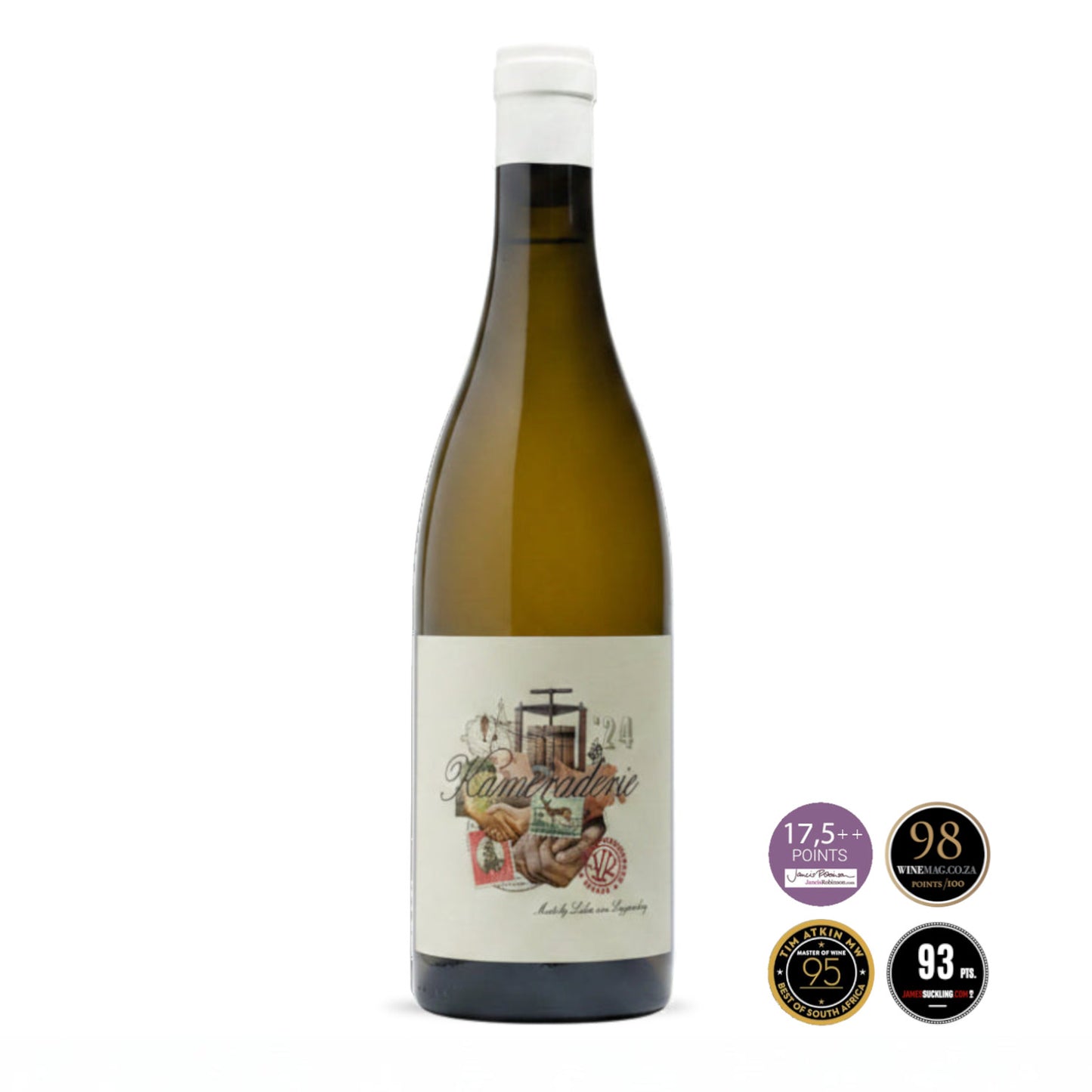
Kameraderie Chenin Blanc 2023 - Van Loggerenberg
Couldn't load pickup availability
Kameraderie Chenin Blanc - Van Loggerenberg
Grape variety: 100% Chenin Blanc.
A wine with a natural and low-intervention approach: it comes from old, unirrigated vines and is vinified without commercial yeasts or enzymes, with predominant aging in concrete to preserve the most authentic expression of Paardeberg, Swartland.
Kameraderie is a tense, textural, and very territorial Chenin Blanc, built more on texture, minerality, and depth than on aromatic immediacy. The nose reveals white pear, ripe citrus, peach/nectarine, floral hints of fynbos, light herbaceous notes like wild fennel, and a clear imprint of decomposed Paardeberg granite.
On the palate it is saline and mineral, with good acidic tension and an important structure. It is not an "easy" or immediately fruity Chenin Blanc: it is more concentrated and slightly austere when young, requiring time in the glass. The finish is long, savory, precise, with an almost tactile/chalky sensation.
A wine for medium to long aging.
Alc. 13% | Cork: natural cork | Residual sugar 1.7 g/L | TA 6.1 g/L | pH 3.24.
Origin
Origin
Wine of Origin Swartland, South Africa.
In the vineyard
In the vineyard
85% of this wine comes from old, unirrigated bush vines planted in 1966, while the remaining 15% comes from vines planted in 1980. The vineyards are located on decomposed granite soils, on the western slopes of Paardeberg.
Over the decades, these old vines have adapted to survive and produce extraordinary grapes under difficult growing conditions. The grapes were harvested at optimal ripeness, resulting in a wine deeply true to its terroir and the place from which it originates.
The soil is decomposed granite.
In the cellar
In the cellar
The grapes were destemmed, pressed, and allowed to settle overnight in stainless steel tanks. Grapes from the 1966 vineyard were fermented in an Italian concrete vat, while grapes from the 1980 planted vineyard were fermented in 500-liter French oak barrels. Both lots remained on their lees for 10 months, without bâtonnage. No commercial yeasts or enzymes were used during the winemaking process.
Awards
Awards
Share

📞 Phone and WhatsApp orders: +39 392 6596 260.
The South African Wine Blog
View all-
South African wines: why they are unique among ...
South African wines are special because they combine ancient geology, oceanic influence, old vines, identity varietals such as Chenin Blanc and Pinotage, and great production freedom. Cape Best selects them...
South African wines: why they are unique among ...
South African wines are special because they combine ancient geology, oceanic influence, old vines, identity varietals such as Chenin Blanc and Pinotage, and great production freedom. Cape Best selects them...
-
Jordan Timepiece: The ancestral beat of Stellen...
The Timepiece range represents the expressive peak of Jordan Wine Estate, a project created to preserve the historic vineyards of Stellenbosch certified by the Old Vine Project. Through the recovery...
Jordan Timepiece: The ancestral beat of Stellen...
The Timepiece range represents the expressive peak of Jordan Wine Estate, a project created to preserve the historic vineyards of Stellenbosch certified by the Old Vine Project. Through the recovery...
-
South African Syrah: Characteristics, Differenc...
South African Syrah is one of the most exciting grape varieties on the international wine scene today. Discover its characteristics, the differences between Syrah and Shiraz, ideal pairings, and the...
South African Syrah: Characteristics, Differenc...
South African Syrah is one of the most exciting grape varieties on the international wine scene today. Discover its characteristics, the differences between Syrah and Shiraz, ideal pairings, and the...